Growth & Marketing
How to Start a Coaching Podcast: Step-by-Step for 2026
11 min read
TL;DR
- Define your show concept before you buy any equipment or record anything.
- Choose a format you can sustain: solo episodes are easiest; interviews grow your network.
- Basic equipment (a USB mic, quiet room) is enough to start.
- Choose a podcast host, submit to Apple and Spotify, and publish at least three episodes on launch day.
- Consistency beats quality every time in the early months.
Starting a coaching podcast is one of those things that sounds simple until you actually try to do it. Pick a topic, record yourself talking, upload it somewhere. Easy, right?
And then you realize you've been staring at a blank document for 45 minutes trying to name the show, you've watched six YouTube videos about microphones, and you haven't recorded a single word yet.
The good news: the technical side of starting a podcast is genuinely simple in 2026. The hard part is the strategic part, and most guides skip it. This one doesn't.
Here's how to start a coaching podcast the right way, from concept to first published episode.
Step 1: Define Your Show Concept
This is the step most coaches skip. They fire up a mic and start talking about "all things coaching" and wonder why the audience never quite materializes.
A coaching podcast needs a specific concept. Not a broad topic, but a specific promise to a specific listener. Answer these three questions before anything else:
Who is this show for, precisely? Not "coaches" or "people who want to grow." A specific person: "women in their 40s navigating career transitions," "new managers struggling with team dynamics," "entrepreneurs who've hit six figures and feel burned out." The more specific your listener, the more they feel like you made this show for them. Generic shows get generic results.
What problem does each episode solve for them? Your show needs a clear value proposition. "Every episode helps [listener] get closer to [specific outcome]." If you can't finish that sentence, the show concept isn't ready yet.
What's your angle or point of view? There are thousands of coaching podcasts. What makes yours different? It could be your methodology, your background, the niche you work in, or your willingness to take positions that other coaches avoid. If you don't have an answer to this, spend another day on the concept before moving forward.
Before naming the show or buying gear, write one paragraph explaining what your show is, who it's for, and why someone should listen to it instead of any of the dozens of other coaching podcasts available. If you can write that paragraph clearly, you're ready to move on. If it sounds vague, keep working on it.
For naming ideas and frameworks, see coaching podcast name ideas.
Step 2: Choose Your Format
The format question trips coaches up more than it should. There are three main options:
Solo episodes. You record alone, sharing frameworks, stories, client patterns (anonymized), and your perspective on specific topics. Solo episodes are the easiest to produce (no scheduling, no coordination, no editing two audio tracks), and they build authority quickly because your voice and thinking are front and center. The downside is that they require you to be compelling on your own, without the structure of a conversation to fall back on.
Interview episodes. You invite guests: other coaches, experts relevant to your audience, or people who've gone through the transformation your coaching addresses. Interviews are easier for many coaches because the conversation carries the episode. They're also a natural networking and relationship-building tool. The downside is coordination overhead and the need for a platform that records both sides cleanly.
Mixed format. Some episodes are solo, some are interviews. This is the most flexible approach and tends to work well for coaches who like variety. The risk is inconsistency, both for you and for listeners who may have a preference.
Honest take: if you're new to podcasting, start with solo episodes. They're more work to sustain on one level (you have to generate all the content yourself), but less work logistically (no guest scheduling, no dual-track audio). Once you've published 20-30 episodes and have a feel for the show, adding interviews is straightforward.
Step 3: Set Up Your Equipment
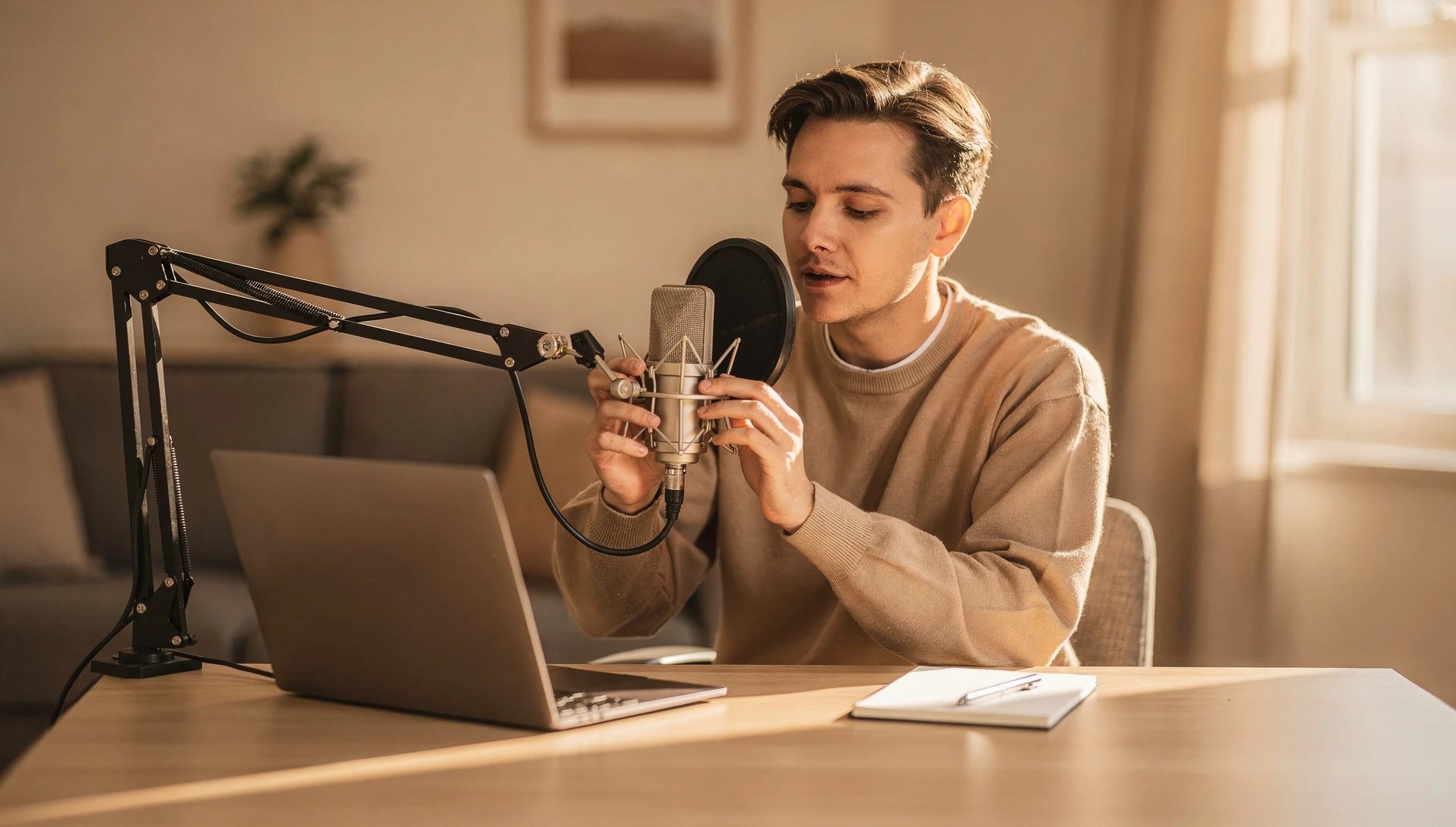
You don't need a studio. You don't need a $400 microphone. You do need decent audio quality, because bad audio is the single most common reason listeners abandon a new show.
The minimum viable setup:
- A USB condenser microphone. The Samson Q2U ($70) and Audio-Technica ATR2100x ($99) are both excellent starting points. Either will produce professional-sounding audio if you use them correctly.
- A quiet room. Soft furnishings, carpet, books, and curtains absorb sound. A walk-in closet is a surprisingly good recording space. Avoid rooms with hard surfaces and echoes.
- A pop filter. Reduces the harsh "p" and "b" sounds that make recordings sound amateur. Most USB mics include one; if not, a $10 foam windscreen does the same job.
- Recording software. Audacity is free and works well for solo recording. If you're recording interviews, Riverside.fm or Squadcast captures high-quality audio from both sides and is worth the $15-$20/month.
For more detailed gear recommendations at different price points, see the podcast equipment guide for coaches.
The room matters more than the mic. A $70 microphone in a treated room sounds better than a $300 microphone in a reverby space with hard walls. Before investing in better gear, experiment with your current room.
Step 4: Choose a Podcast Hosting Platform
Your recordings need to live somewhere before they can be submitted to Apple Podcasts, Spotify, and other directories. That's what a podcast host does.
The main options coaches use:
Buzzsprout is probably the most beginner-friendly, with clean analytics and a straightforward publishing flow. There's a free tier (limited), and paid plans start around $12/month.
Podbean offers a solid free tier and is well-established. Good for coaches on a tight budget who want to get started without a monthly commitment.
Transistor is more flexible and allows multiple shows under one account. Better for coaches who might launch more than one show or run a brand alongside a personal show.
Spotify for Podcasters (formerly Anchor) is free and owned by Spotify, which gives it natural advantages for Spotify distribution. The analytics are improving, though still less detailed than dedicated hosts.
The differences between platforms matter less than getting started. Pick one and go. You can migrate to a different host later if needed; most hosts support this cleanly.
Step 5: Plan Your First Episodes
The number one reason new podcasts die is that the host ran out of episode ideas. Before you record anything, write out 20 episode concepts. If you can't get to 20, the show concept may be too narrow (or not specific enough to generate focused content).
For your first batch of episodes specifically:
Record at least three before you launch. Launching with three episodes gives new listeners something to binge. It also signals that you're serious. A single-episode launch feels more like a trial run than an actual show.
Start with your strongest material. Episode one is not the place to warm up. It's the place to deliver something so valuable that the listener immediately hits subscribe. Save your tentative topics for episode 20 once you've found your stride.
Make episode one a strong introduction to you and the show. Not a trailer (those often feel thin), but a real episode that also sets the stage. Tell listeners who you are, who the show is for, and what they can expect. Then deliver the actual content.
Step 6: Record and Edit
Once you've got your concept, equipment, and episode plan, recording is the straightforward part. A few practices that make a meaningful difference:
Warm up before you record. Read a page out loud, have a conversation, do something to get your voice loose. Cold recording sessions often sound stiff and take longer to relax into your natural voice.
Speak to one person, not an audience. Imagine a specific person who represents your ideal listener and talk directly to them. Podcasts that feel like speeches don't connect the way conversations do. "You" works better than "listeners" in almost every context.
Don't over-edit. Remove obvious mistakes, long silences, and major stumbles. Don't strip out every "um" or pause. Natural speech patterns are part of what makes audio feel human rather than scripted. Aim for clean but not surgical.
For editing software: Descript deserves a mention here. It edits audio using a text transcript, which is dramatically faster than traditional waveform editing for coaches who aren't audio engineers.
Step 7: Submit to Directories
Once you have your feed set up on your hosting platform and at least one episode published, submit your show to directories. The two that matter most:
Apple Podcasts. Takes 1-3 business days for approval after submission. Requires an Apple ID. Submit through podcastsconnect.apple.com.
Spotify. Usually approved within 24 hours. Submit through podcasters.spotify.com.
Submit to both before you announce your launch. Also consider Pocket Casts, Amazon Music, and iHeartRadio. Most hosting platforms have a distribution tool that handles this automatically.
Step 8: Set Up a Publishing Workflow
This is the step most new podcasters skip, and it's why they stop publishing consistently after episode 10.
A publishing workflow is just a repeatable system: what you do each time you record, edit, and publish an episode. It doesn't need to be elaborate, but it needs to exist. Without it, every episode requires starting from scratch mentally, which creates friction that compounds over time.
A simple workflow:
- Record (and trim start/end)
- Basic edit (remove major errors, long silences)
- Add intro/outro music if using it
- Export and upload to hosting platform
- Write show notes (short description + key points + links)
- Schedule the episode and publish
- Send one email to your list and post on social
Write that list down. Time each step once so you know how long publishing takes. Then block that time on your calendar for each episode cycle.
Coaches who get into the habit of repurposing podcast content early, turning each episode into a blog post, social clips, and newsletter content, dramatically increase the ROI from every recording session.
What Comes After Launch
The first few months after launch are usually the hardest. Growth is slow, the audience is small, and it's easy to wonder whether anyone is listening. Some are. Keep going.
The most important thing you can do in the first 90 days: show up consistently and ask your existing audience (email list, social followers, current clients) to leave reviews on Apple Podcasts. Early reviews help new shows get seen in search results and send a signal that the show has real listeners.
The second most important thing: start guesting on other shows immediately. Even if you've launched your own podcast, appearing on other shows grows your audience faster than almost anything else. The full strategy for landing podcast guest spots is in how to get booked on podcasts as a coach.
Building a podcast audience takes time. But coaching is a long-game business. The coaches who are still publishing 12 months from now, with a clear concept and consistent execution, will look back on the early episodes and realize that the patience was the whole strategy.